Lichens and Rocks

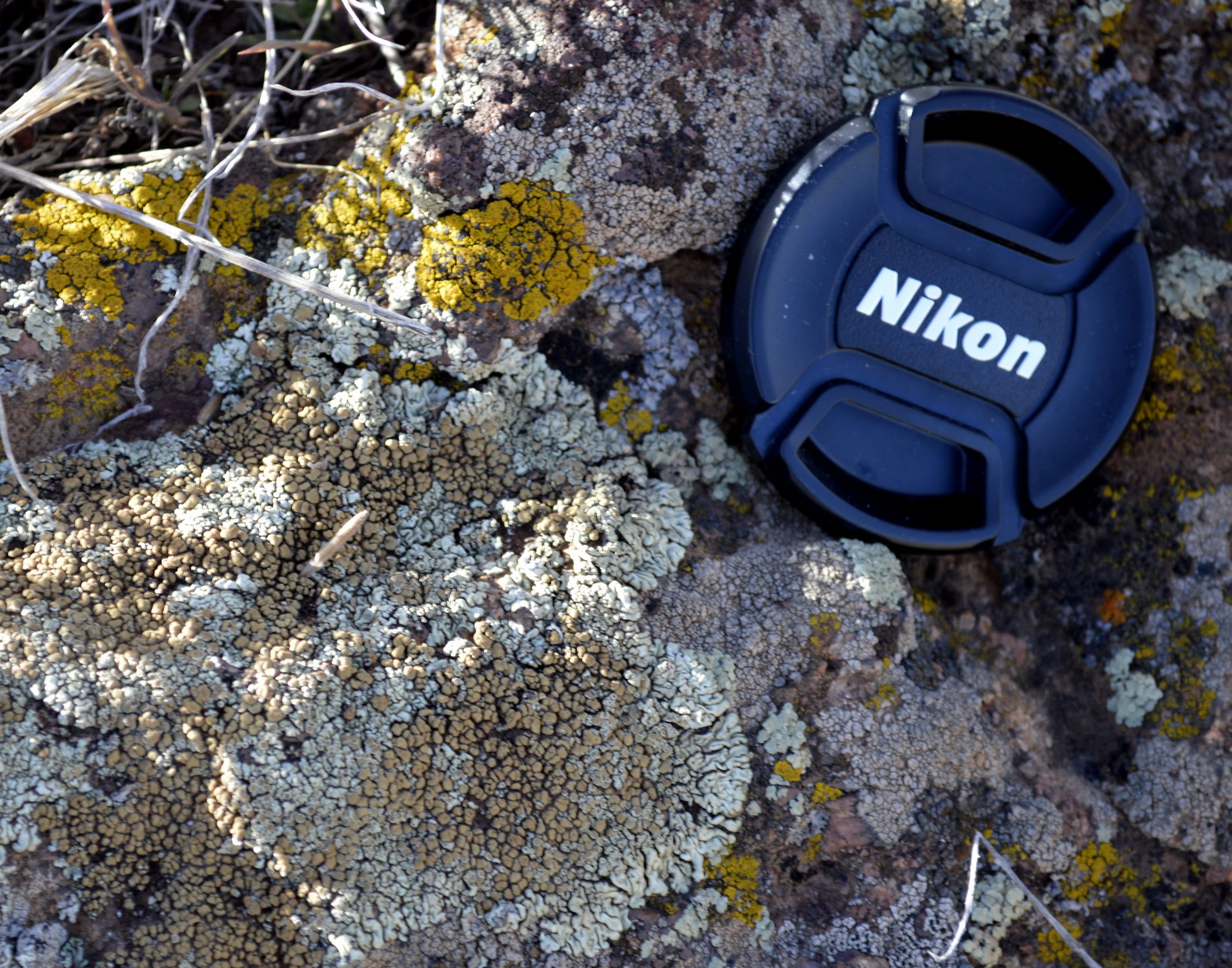
saxicol0090Lichens that grow on rocks are called saxicolous, and a great many species fall into this category. These are the bright splashes we see when out hiking or just enjoying the scenery. But did you know that some of them have distinct preferences in the types of rocks they grow on? Their occurrence is not haphazard; they need to find the correct substrate, and knowing the preference for a particular species can help you locate it!

Substrate Specificity

The preference of lichens for a particular rock type can be based on chemistry: is the rock basic or acidic? Limestones, which are relatively sparse in our area, often support lichens that may not be seen elsewhere. Other species will be found on sandstones or the granitic or metamorphic rocks of our mountain areas. The cement of sandstones can be either calcareous (basic) or siliceous (acidic), which determines which lichens it will support.

For example, Xanthoparmelia species will generally be found on siliceous rock types, and thus are common in the granitic or metamorphic substrates so abundant in the Rocky Mountains and other places where igneous or metamorphic rocks dominate.

Bright orange Xanthoria elegans responds to environments high in nitrogen, and can often be seen in broad swaths below bird or rodent perches.
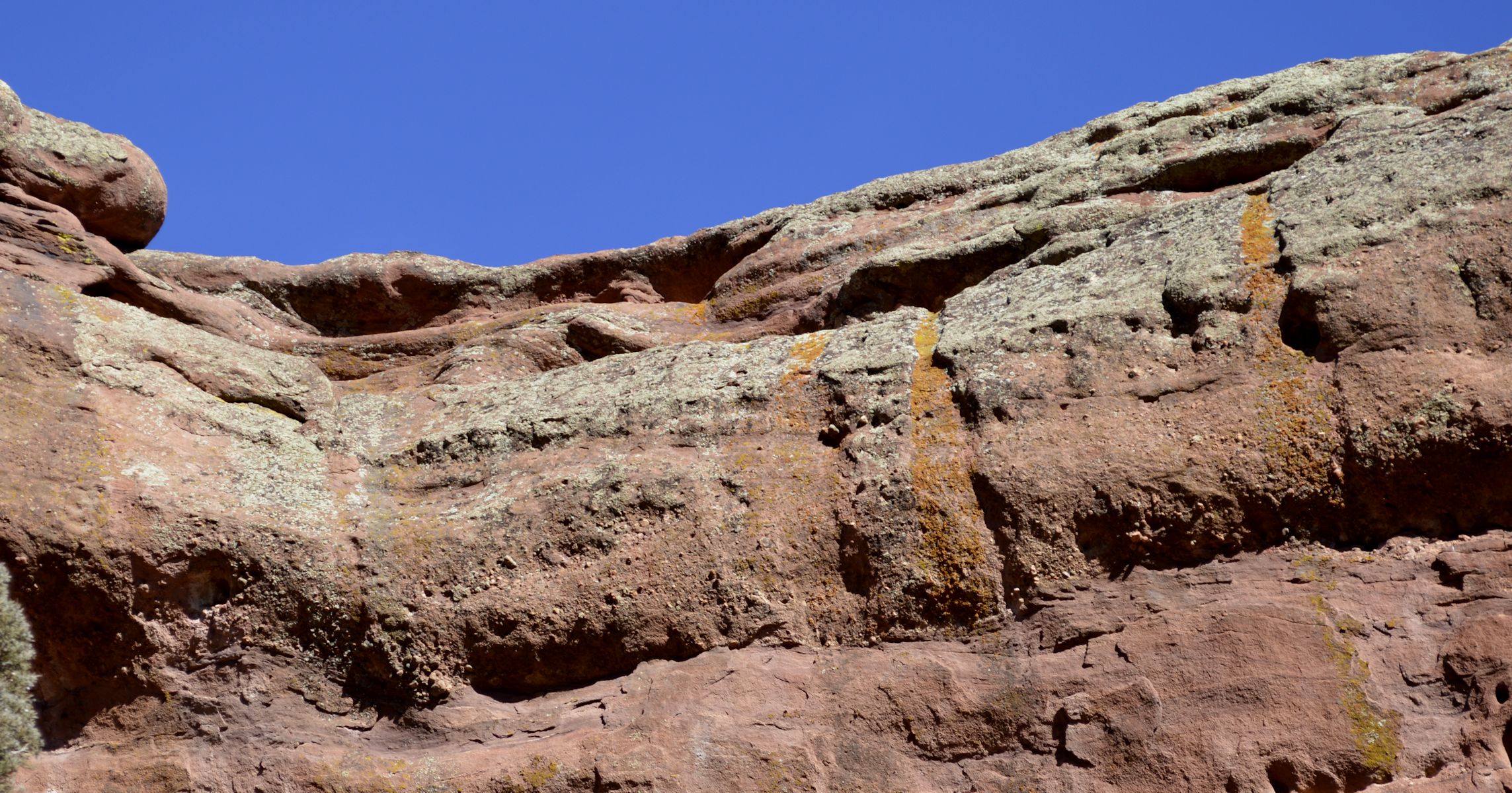
Bright orange Xanthoria (probably X. elegans) grows in channels where nutrients are washed down from animal perches. Fountain Sandstone, S.L. White.
Bright orange Xanthoria (probably X. elegans) grows in channels where nutrients are washed down from animal perches. Fountain Sandstone, S.L. White.


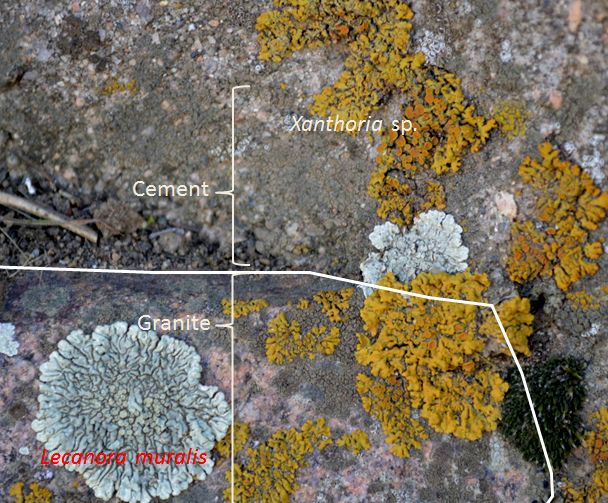
The same species seem to occupy both cement and granitic stone in this wall. S.L. White.

The same species seem to occupy both cement and granitic stone in this wall. S.L. White.

Lecanora muralis, a cosmopolitan species across the U.S., occurs on various rock types, also likes nitrogen, and often colonizes cement and mortar because of their high calcareous content. Because it appears on manmade surfaces, it has been called “stonewall” lichen (in fact, muralis is Latin for “of the wall.”) On the stone wall in my backyard, however, it appears equally happy on the granite cobbles as on the adjacent cement.

Lichens and Weathering

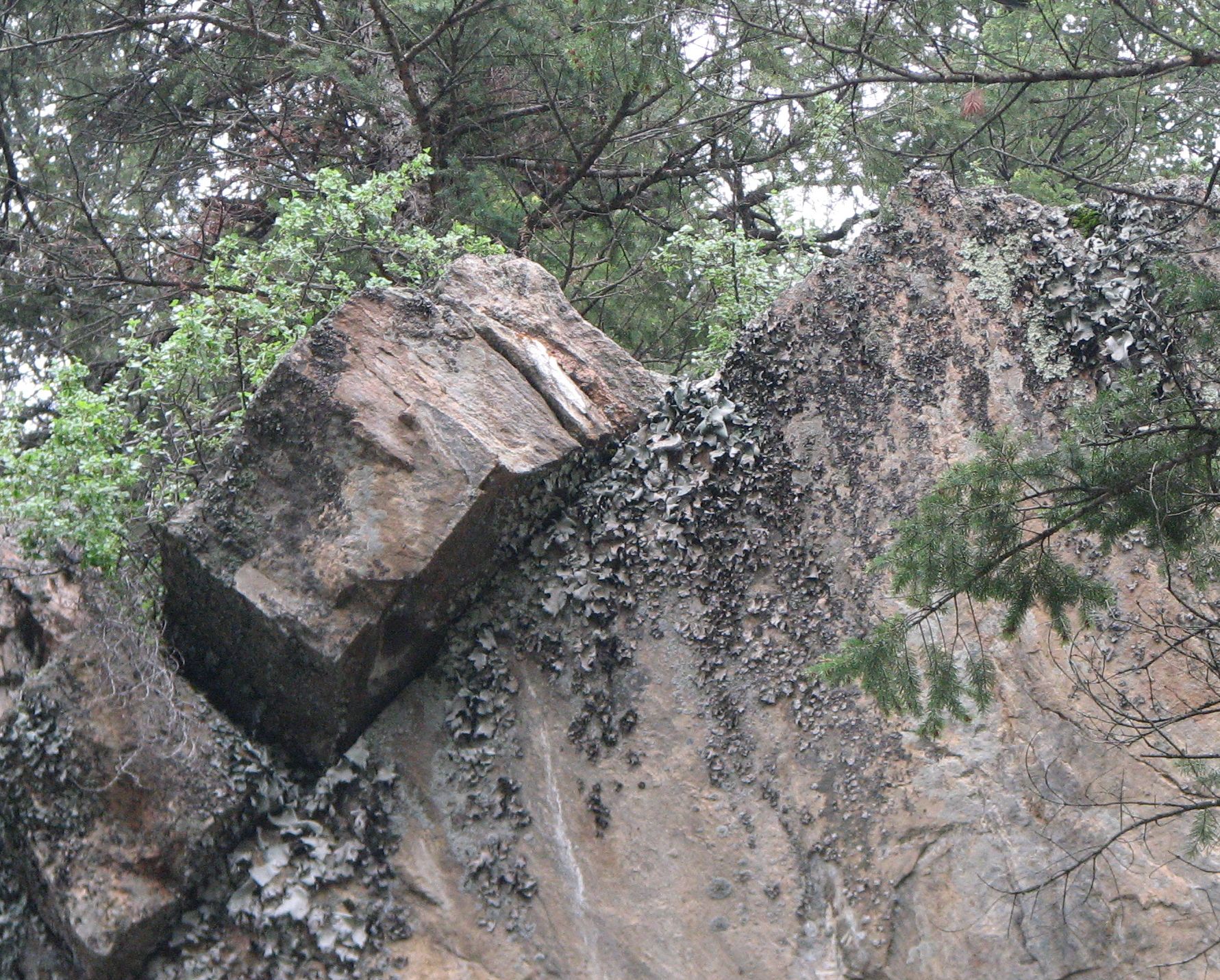
On this boulder of Fountain Sandstone, lichens are assisting in the weathering of the rock by exfoliation, or spalling. Photo by S.L. White.

On this boulder of Fountain Sandstone, lichens are assisting in the weathering of the rock by exfoliation, or spalling. Photo by S.L. White.

Lichens also help break down rock, as we learned when we were young. Their chemical and physical interaction with the substrate on which they grow can be significant. Crustose lichens, in particular, closely interact with their substrate and are so abundant they play a significant role in weathering processes.

Direct penetration of rhizines, in the case of foliose lichens, or medullary hyphae in crustose lichens may physically fracture rock surfaces. Once imbedded within a rock, expansion and contraction of lichen thalli with changes in temperature and hydration status will contribute to the pressures that result in surface disintegration of rocks.  —Nash et al., page 153
Umbilicaria, or Rock Tripe

Umbame1882Umbilicaria americana, FROSTED ROCK TRIPE
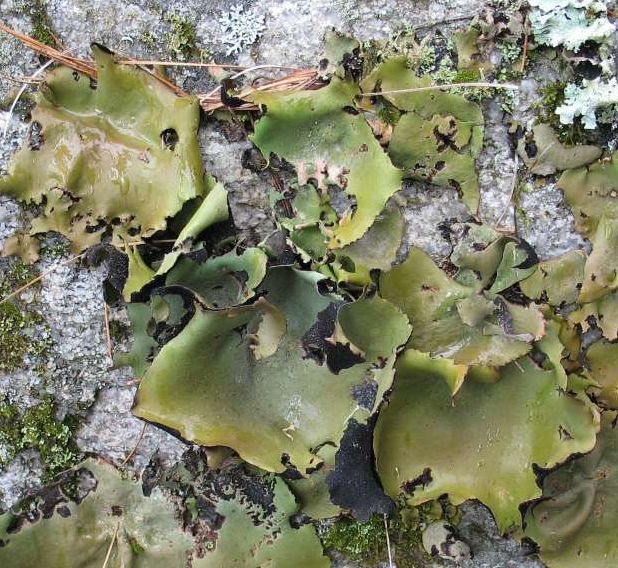
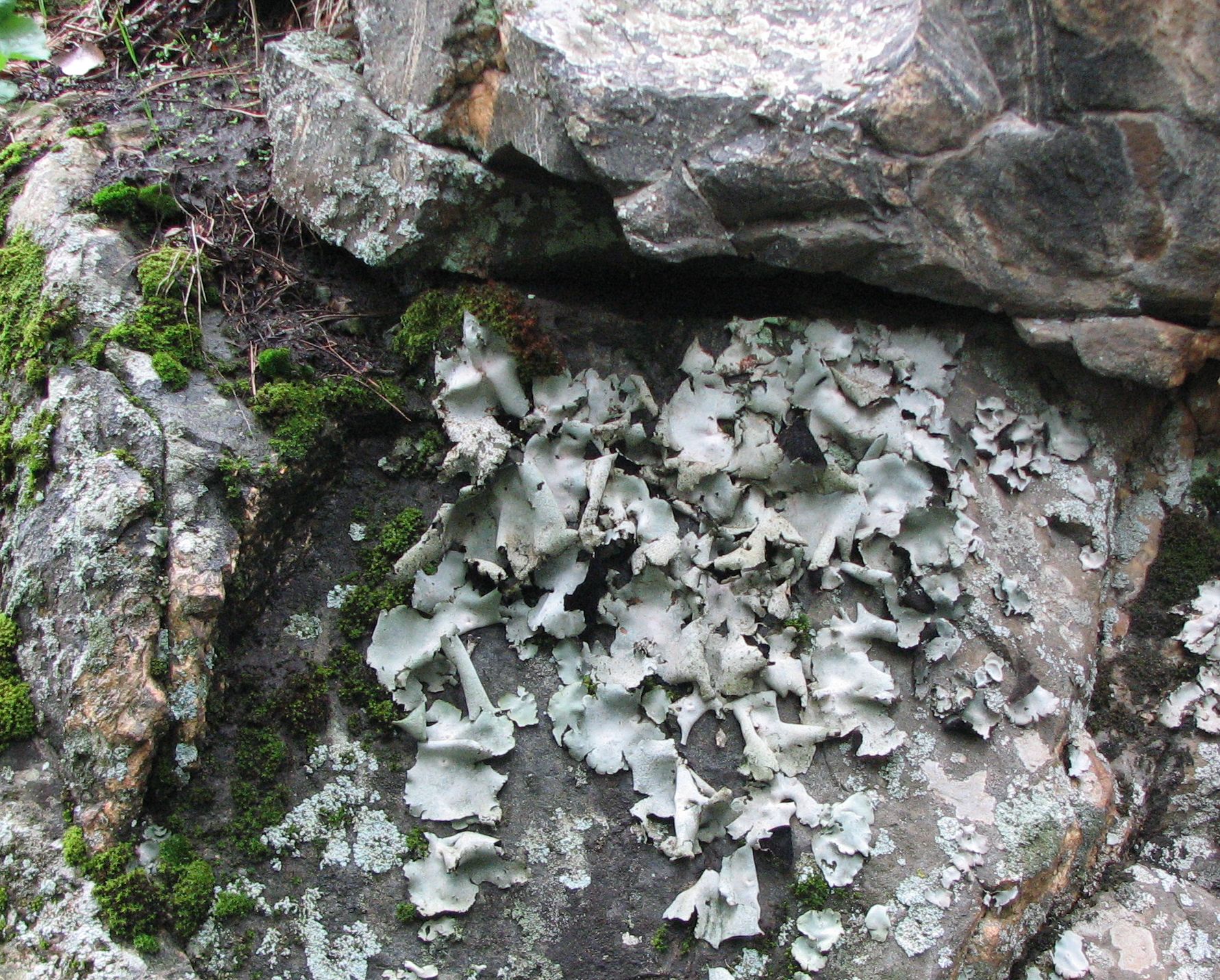
This species and its relatives are known as “rock tripe” and said to be edible, though perhaps only in dire situations. For example, the related species Umbilicaria mammulata reportedly fed George Washington and his starving troops during the harsh winter of 1777 at Valley Forge. A distinctive and abundant lichen on moist, vertical cliff faces in the Front Range, it lacks apothecia and has a sooty black underside covered with rhizines, creating a velvety appearance.

umbil2346smThalli are leathery (and green!) when wet, and are “umbilicate” (attached only at one central point); they can be 15 cm across. Largest and most notable of our umbilicate species, this often grows in huge colonies.

Another large species of Umbilicaria, this brownish one with abundant black apothecia and a more wrinkled upper cortex. Perhaps U. hyperborea.

Fun fact: Some species of Umbilicaria have intriguing black “gyrose” apothecia with concentric fissures. This species, however, is rarely seen with apothecia.

Don’t be fooled: Umbilicaria vellea is similar, but usually smaller and generally found at higher elevations or latitudes. Details of the rhizines distinguish the two.

A monotypic colony of Umbilicaria on metamorphic rock cliffs in Bear Creek Canyon, Jefferson Co., Colorado.

A monotypic colony of Umbilicaria on metamorphic rock cliffs in Bear Creek Canyon, Jefferson Co., Colorado.

Old Man’s Beard, the Genus Usnea

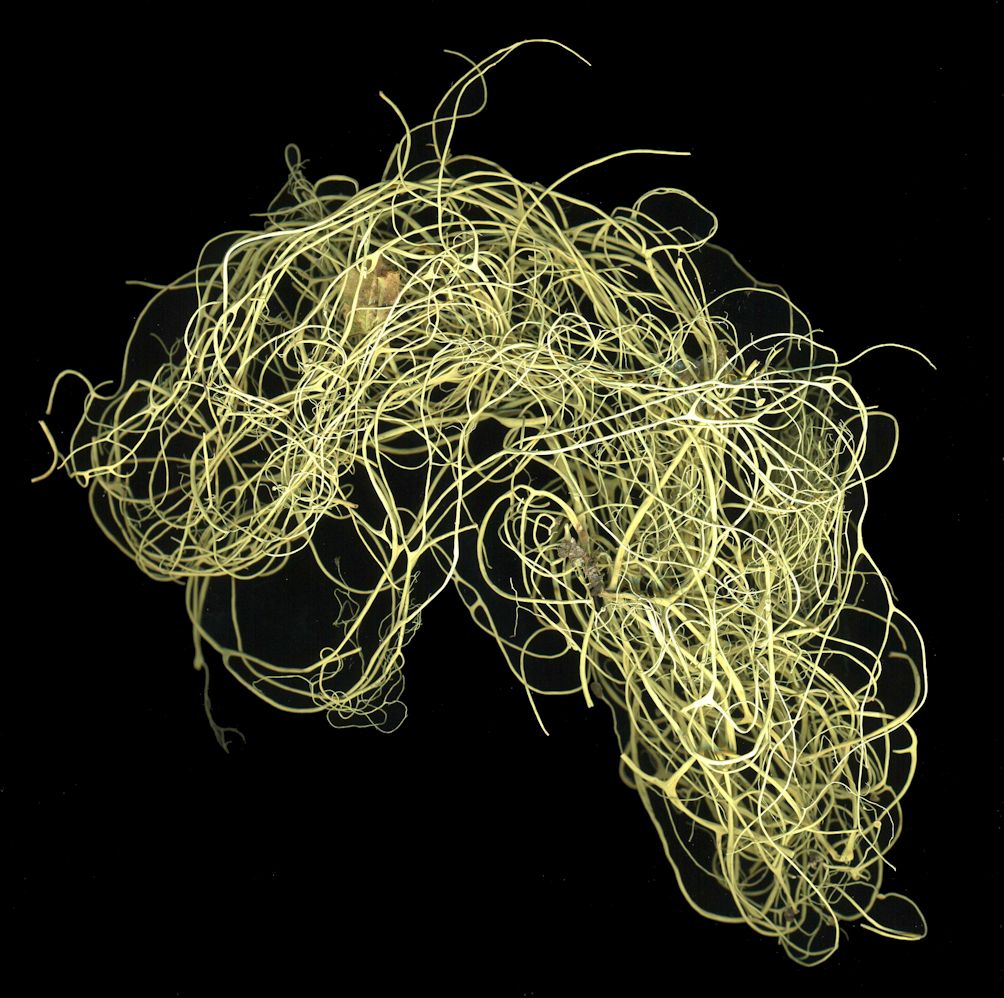
Long pendulous thallus of Usnea cavernosa, found on conifers in Rocky Mountain National Park, the San Juan Mountains, and other high elevations in Colorado. Not common here; this scan is of a specimen from Idaho.

Some fruticose lichens form long webs, dangling from tree branches, that acquire common names like “tree hair” or “old man’s beard,” especially in places like the Pacific Northwest, where high humidity and tall trees support their robust expression. From a distance, these resemble the “Spanish moss” of southern states (which is neither moss nor lichen).

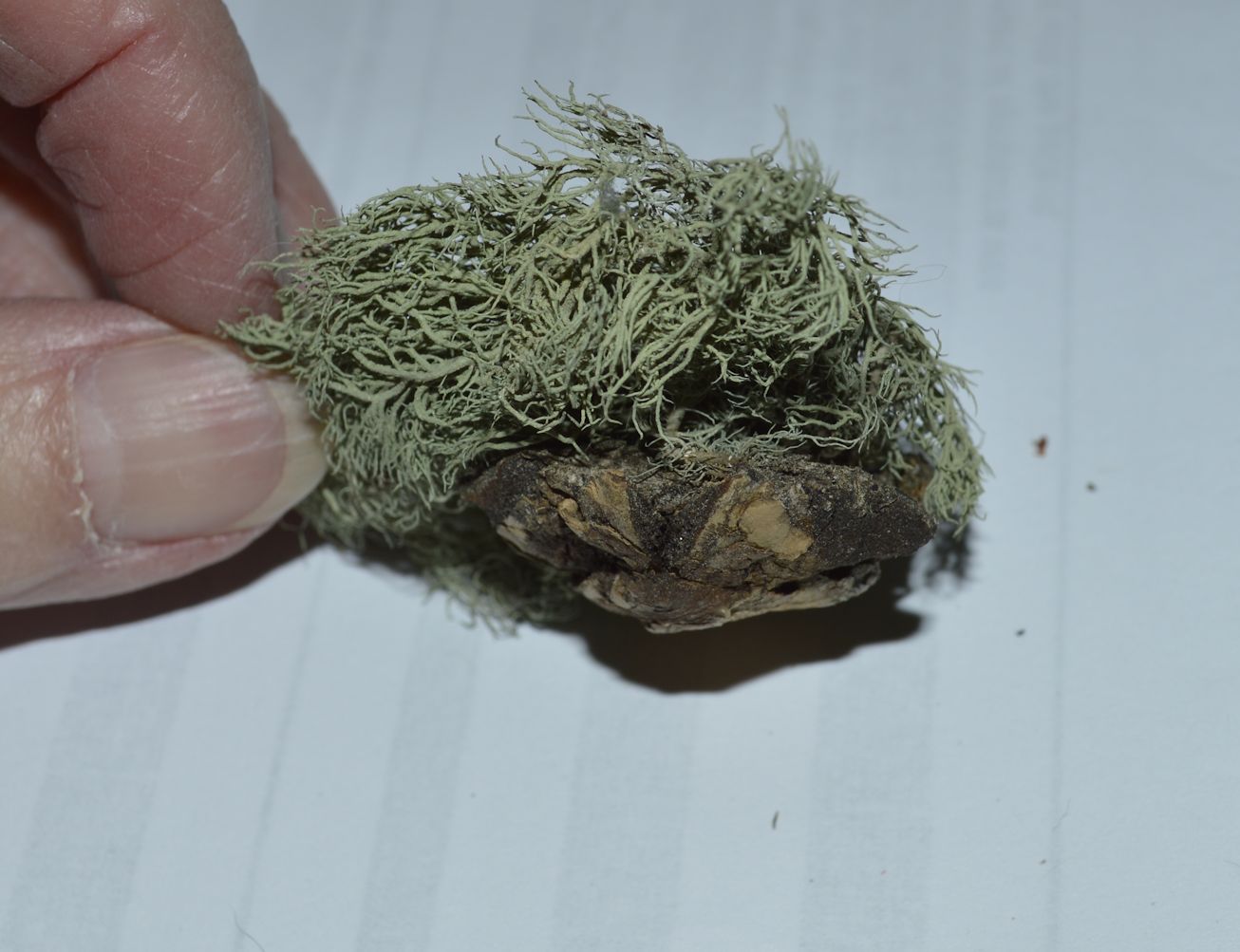
Common species of Usnea, such as U. hirta and U. subfloridana, occur on conifer bark and are small and shrubby.  At higher elevations with adequate moisture, larger species like U. cavernosa may be seen.

Common species of Usnea, such as U. hirta and U. subfloridana, occur on conifer bark and are small and shrubby. At higher elevations with adequate moisture, larger species like U. cavernosa (at top) may be seen.

More common in our Colorado forests are species of Usnea that display themselves less dramatically. Most are no more than a few inches tall (or long) and are frequently seen on bark of conifers like Douglas-fir and Colorado or Engelmann spruce. (Oddly, however, not on ponderosa pine.)

A closer view of this same specimen is below; click to enlarge further.

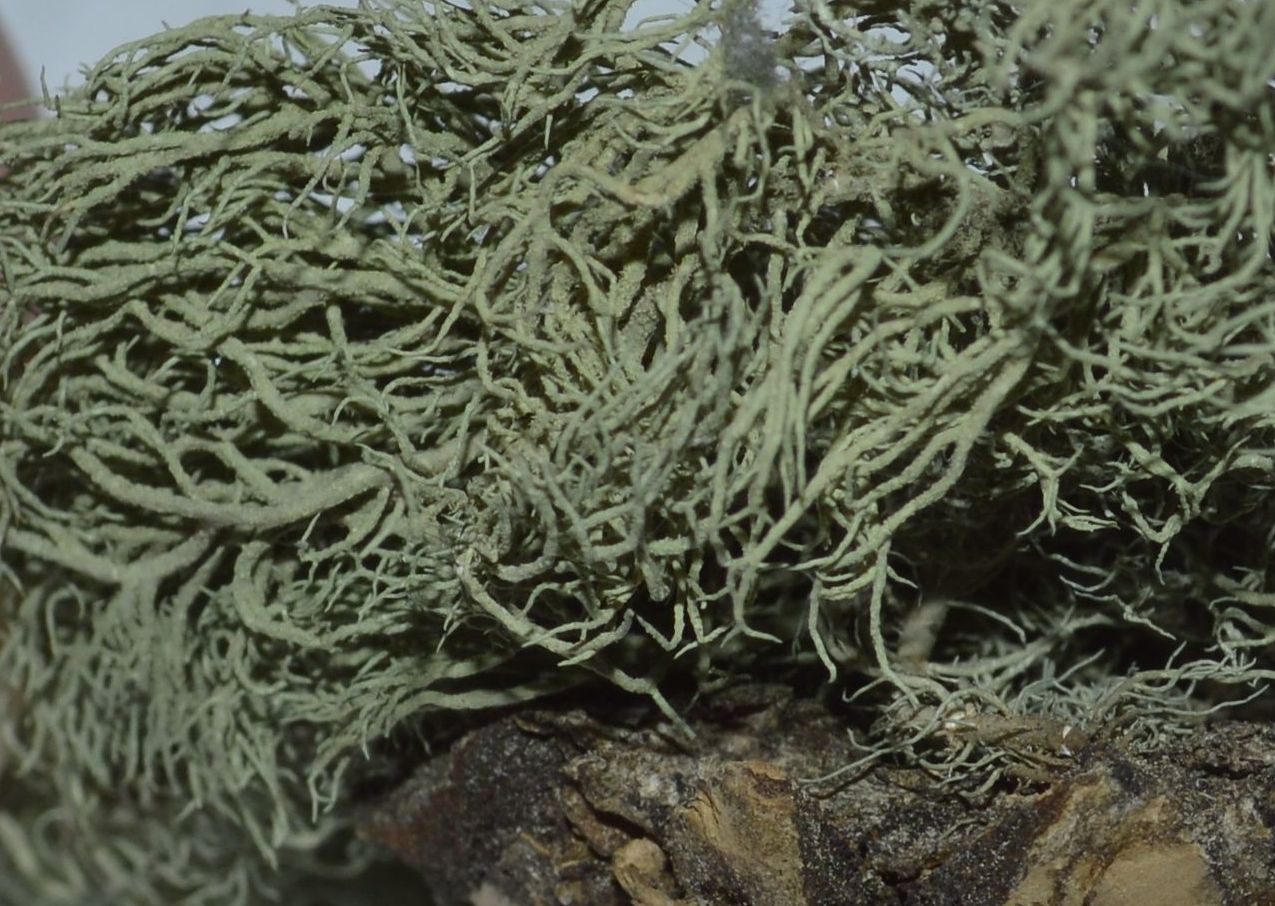
A close-up of the same lichen shows the tangled branches characteristic of the Usnea thallus. Each branch has a tough central cord, which distinguishes this genus from other light-green arboreal species.

A close-up of the same lichen shows the tangled branches characteristic of the Usnea thallus. Each branch has a tough central cord, which distinguishes this genus from other light-green arboreal genera, like Evernia and Ramalina.

Detailed description of Usnea cavernosa
More Usnea photos (at Ways of Enlichenment)
List of Usnea species and photos (at Sharnoff Lichens)

Peltigera leucophlebia

Or is it Peltigera aphthosa? Only by peeking underneath can you be sure! This post was published as a lichen profile in the Winter 2013 issue of Aquilegia, newsletter of the Colorado Native Plant Society (Vol 37, No. 6). Back issues are available online at the CoNPS website..

Peltigera leucophlebia, Peltigera aphthosa

Photo by Rick Brune.

Photo by Rick Brune.

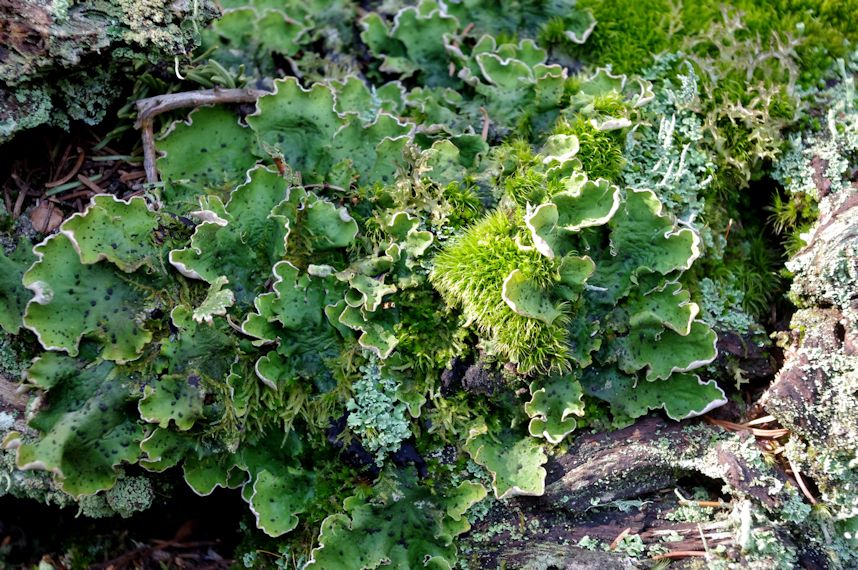
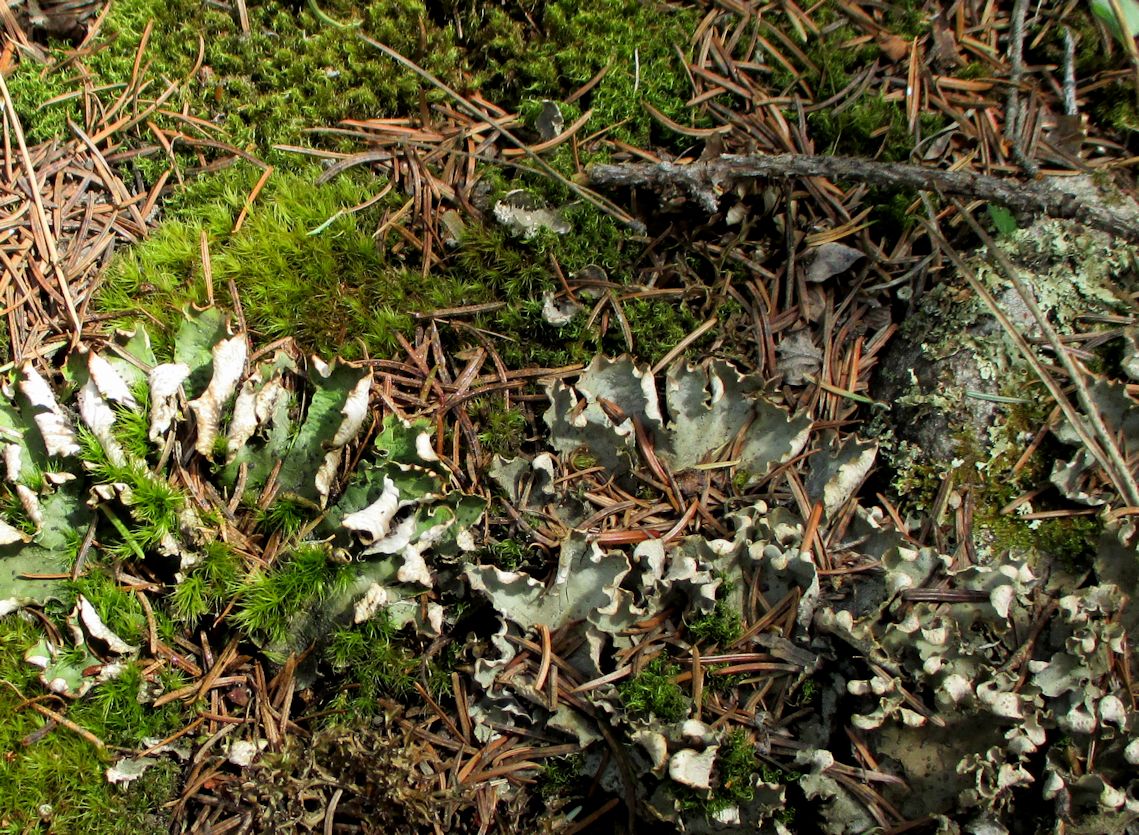
Broad, ruffled lobes would place the abundant “pelt” lichens among the most noticeable of our montane lichens, were it not for their usual cryptic brown and gray coloring. Fortunately three of our 15 species stand out, at least when wet, thanks to the chlorophytes that are their primary photobionts. Peltigera aphthosa and Peltigera leucophlebia (clear veins) are large lichens with bright green coloring that helps us spot them when the forest floor is moist. The 2-4 cm wide lobes radiate to form a thallus 30 cm or more across.

To distinguish these two species, you’ll probably have to take a peek at the underside. P. leucophlebia, as its name implies, has distinct veins that change from light colored near the margin to black toward the center. Carefully loosen the lichen from the soil or mosses to check for this. In P. aphthosa, the veins tend to be broad and undefined. The uplifted lobes bearing brownish apothecia have, in P. aphthosa, green cortex on the underside of these reproductive structures, but in P. leucophlebia, the cortex is absent or present only as green specks on the white background.

Fun fact: Round dark structures on the upper surface, called cephalodia, contain cyanobacteria, giving these lichens claim to a three-kingdom symbiosis.

Don’t be fooled: Species of Sticta look like Peltigera and are in the same family, but the underside is black with white spots instead of the characteristic veins. Our third green Peltigera, P. venosa, is smaller (less than 2 cm diameter) and each fan-shaped thallus consists of a single lobe, usually with black marginal apothecia.

Scans of upper (left) and lower (right) surfaces of Peltigera leucophlebia, by Richard Brune.

Scans of upper (left) and lower (right) surfaces of Peltigera leucophlebia, by Richard Brune.

Exploring our lichen world

Several of us took a field trip yesterday to look at lichens and specifically to find lichens that were especially interesting and unusual. We succeeded completely! In our group was a new member of the Native Plant Society who had an interest in learning more about and photographing lichens, mosses, and other often overlooked small beings that we find in nature. His interest and talent have me spending time with the books again, refreshing all the things I used to know and picking up a few new ones in the process. He’s also promised to share his photos on this website soon.

Right before a sad mishap with my brand new camera, I caught this picture:

This lovely Peltigera aphthosa (or maybe P. leucophlebia) was not the most exciting lichen we saw all day, but it was the best, and pretty much the only, photo I captured. Being out looking at lichens means hope for an updated website here, but having a new photographer on board brings the certainty of MUCH better pictures! Stay tuned…