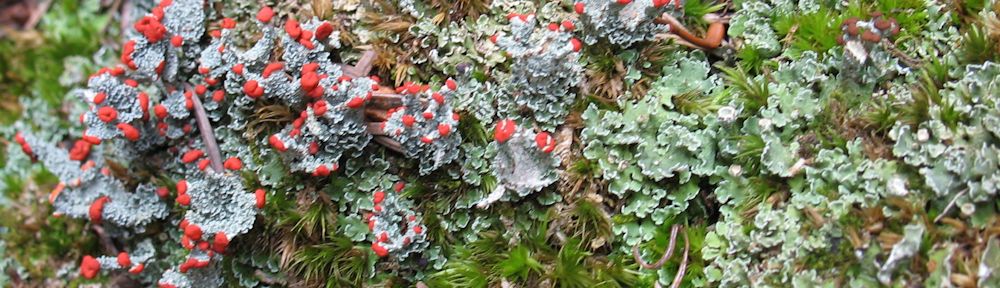
New Years and Plans for the Future

Another new year and things have been quiet over here at Colorado Lichens, but we’ve got some big plans for the future.
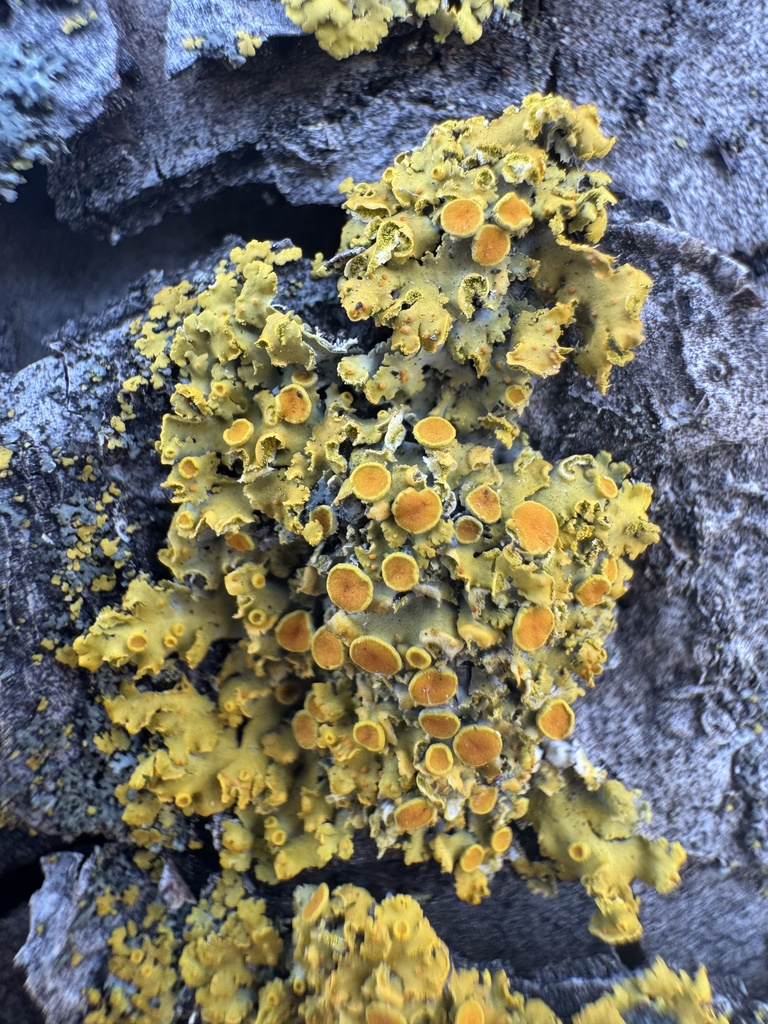
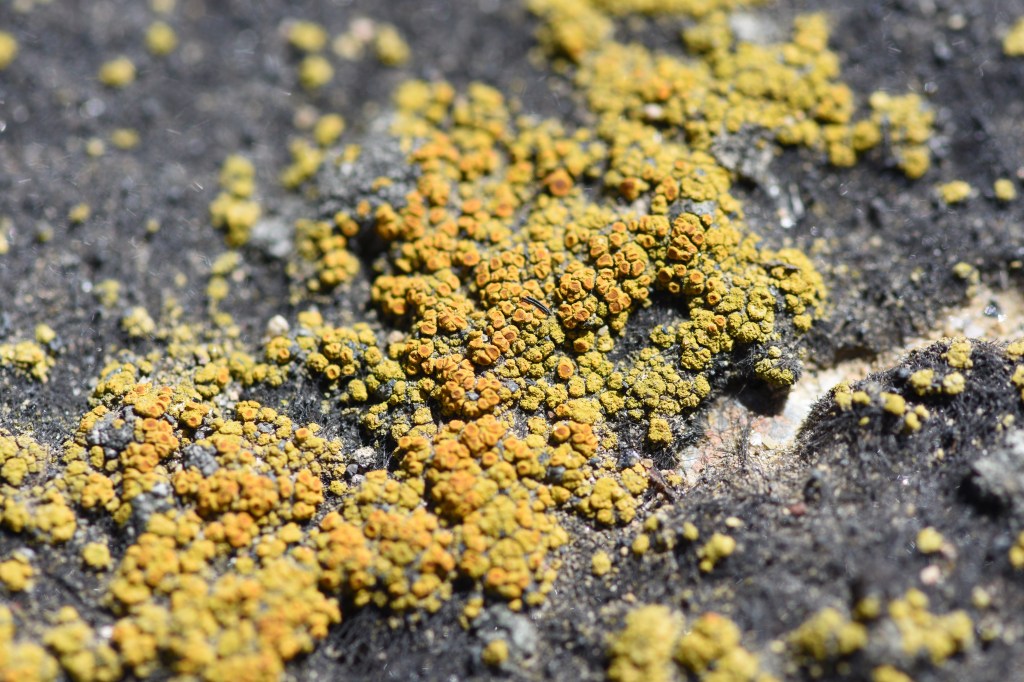
Xanthomendoza montana or at least that’s my best guess for today. If you look close, almost as good as those New Years fireworks.

Since starting some work on the website in 2022, I’ve been wondering what the website should be. Now I have a plan for the next few years. Since starting my pursuit of learning the lichens, one thing has really stuck out to me, and that is the absence of recent information about Colorado lichens. The books in my collection oriented for the state are wonderful books, but are now many decades old. The state doesn’t even have a full published catalogue of the species that are present in the state1. So, the goal for the site to come is two-fold.

  • To provide the tools to identify Colorado lichens. The best resources for lichens are jargon heavy and highly technical. Often, they require collection and microscopy of lichens. We can’t let go of words like perithecia and rhizines, but we can define those for you and call something bumpy versus rugose.
  • Focus on which lichens can be identified in the field! In the early days of ornithology, many birds were considered impossible to separate in the field. Surely strides can be made with lichens as well. Provide resources and accounts for the lichens of Colorado. Can we follow in the footsteps of other great regional nature websites?

If you poke around the site, you will see that this is already starting to be built.

  • An illustrated glossary for the terms you need to learn. Sorry all the jargon can’t go away.
  • Lichen flora of key Colorado habitats
  • Taxonomy of lichens. Currently an overview of the major taxonomic groups, hopefully someday information about the species that call Colorado home.

I’ve decided to publish these improvements as I go, instead of waiting for finished products. This means there will be mistakes, typos and corrections to be made. Watch out I am a perfect example of the Dunning–Kruger effect. Currently, learning just how much I don’t know.

A bit more about the topic of citizen science and the role of amateur naturalists

This is something I am really passionate about. So, excuse me while I talk about birds for a while, my first passion. Before the advent of binoculars, ornithologists had to shoot their birds to learn about them. The great bird explorers of the 1800s, like James Audubon, carried not a camera and binoculars but a shotgun. Texts about birds used dichotomous keys, and relied heavily on measurements. The names for birds were all in Latin, and ignore the names everyday people used for them. Roger Troy Peterson published A Field Guide to the Birds in 1934, revolutionizing the identification of birds in North America2. He coined the Peterson Identification System, which used a combination of visual identification marks to identify birds, instead of the jargon heavy scientific literature at the time. Around the same time, consensus built around the common English names for birds. However, the scientific community did not change at the same pace. It still required the same methods for scientific data collection, often disregarding layperson observations as un-scientific. Yet the revolution continued and the birding community got better and better at field identification. Species Peterson himself may have thought inseparable became routine identifications. The laypeople outnumbered the scientists 100s to 1.

Then came the next massive change– the internet and eBird. Now all these experienced birders could document their sightings and share them. The advent of digital cameras allowed for photographic documentation. Birders could create datasets scientist could only dream of: abundance, changes to historical distribution, and year to year variations. Hundreds of papers are published using eBird data each year. The scientific community finally switched from only allowing their own data to relying on that generated by the amateur too3. We are right at the start of the next revolution, artificial intelligence4 assisted identifications.

This same revolution is now taking place in most other kingdoms of life. Plants, mammals, fish– just about everything have identification guides using Peterson’s principles. Millions of data points are gathered on sites like iNaturalist.

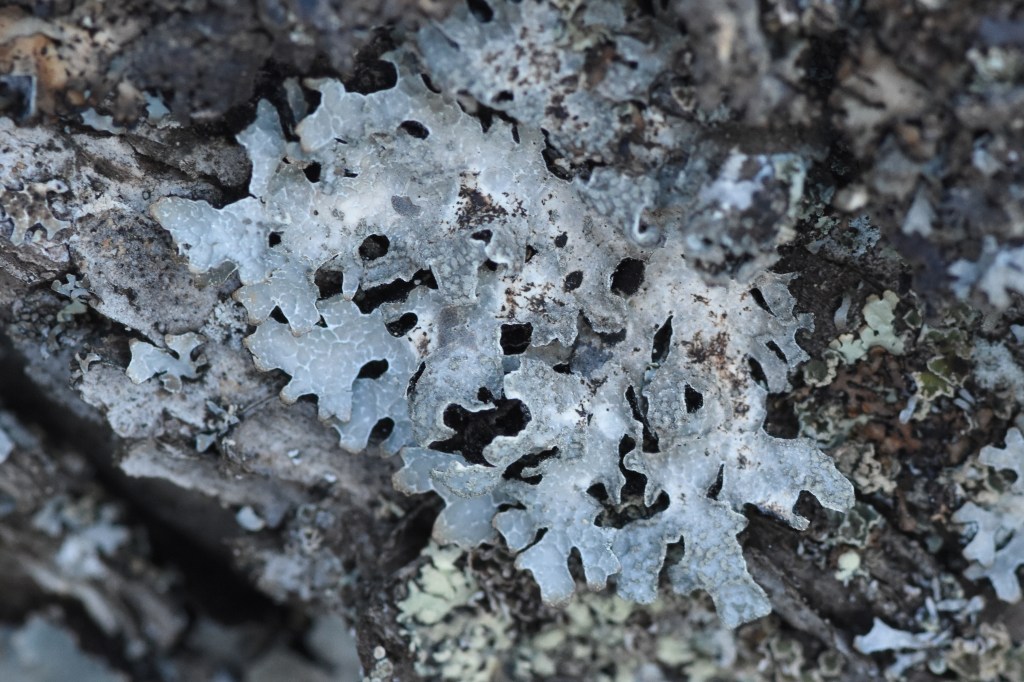
But what of the organisms small and understudied? The moss, the liverworts, and yes the Lichens. Maybe someday down the road Colorado Lichens can be a little part of the puzzle that brings our Lichen flora out of the dark ages of specimen packets, microscopes, and dichotomous keys to a field guide that anyone can pick up and feel secure in knowing they are looking at a beautiful Pannaria tavaresii5.
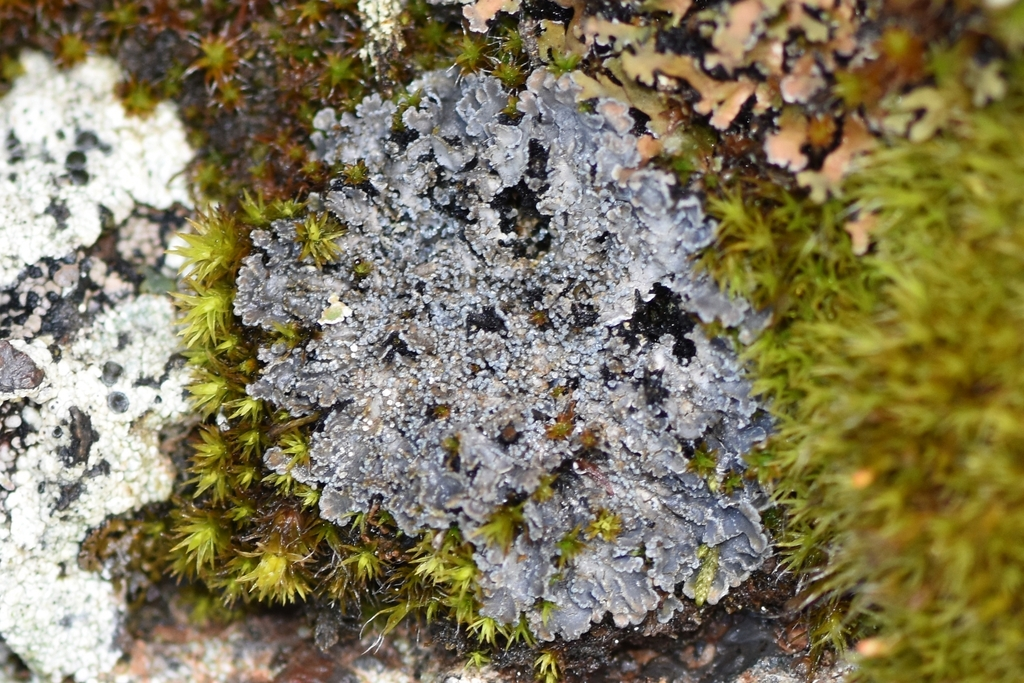
Pannaria tavaresii Saguache County, CO.

So let’s get into the field, pick up our cameras6, stare at some beautiful thalli and figure out who exactly our Colorado Lichens are. 

Footnotes

  1. I have to give credit to William A. Weber who has complied the best information on Colorado Lichens, including several iterations of a checklist of Colorado Lichens. I cite his work often.
  2. As any good story, the truth tends to get in the way. I was able to find an article that mentioned Florence Augusta Merriam‘s Birds Through an Opera-Glass, published in 1889, as the first field guide to birds. I don’t doubt that similar works were written in Europe as well.
  3. There is obviously a need for serious scientific research, using the same tried and true methods. However, especially in understudied groups, I like to think the general public can still contribute greatly.
  4. I’m actually not aware of any true AI being used. Right now the models rely on machine learning. I am only aware of iNaturalist including lichens. It already recognizes some of the easy ones!
  5. Someday we will need common names for lichens! It really is the dark ages.
  6. Make sure to submit your lichen observations to iNaturalist or your other favorite site.

Life Finds a Way

Underpass to the Highway 36 onramp on Baseline Road, Boulder.

You may well be asking why on earth I have started this post with a picture of an underpass, but on a windy day in Boulder here I was.

I have always been fascinated by the life that manages to persist in heavily disturbed urban areas like the plants sprouting through cracks in the sidewalk. While sometimes easy to simply dismiss the life that persists in these places, to wish that native species could be flourishing instead of the non-native weeds, bugs and animals, I think learning what can live in the midst of all of humanity is a worthwhile task. As I set off my soap box I present to you one such organism.

Flavoplaca citrina (tentative) – Growing on a synthetic fiber. See the retaining wall on the left side of the top photo and you can just barely see the black material with yellow crust on top.

I was quite surprised to see large patches of a yellow lichen growing on some material presumably used to help keep the dirt in place on the retaining wall. I was even more surprised when I looked closer and determined it was a species I had clearly never seen before. When attempting to key out this specimen I had no good answer it asked me what substrate it was growing on! If you believe it construction material wasn’t an option. Presuming I have the species correct in Tom Nash’s excellent Lichen Flora of the Greater Sonoran Desert Region. Vol 3 possible substrates for the species are “on wood, bark, bryophytes, non-calcareous or calcareous rocks.” This to me shows that the species can be rather opportunistic when it comes to where it can grow. Perhaps a reason it chose this man-made material as a home.

Next time you are on a walk through the city and you see a splash of color where you don’t expect take a closer look you may just find a lichen adapting to the new urban environment we have created.

Flavoplaca citrina (tentative) – Showing off it’s apothecia (bright orange discs with yellow rims) which were present on some but not all colonies of the lichen.

One of the main reason’s I wanted to start writing on lichens is to show others how to start identifying them. So watch out I’m going to get technical down here and describe this lichen.

Let’s start with a description of the thallus. Step one, it has a thallus, this is the yellow portions in the above photo, and is the main body of the lichen. In some of the small crustose species the entire thallus can be hidden within the substrate and only the apothecia are showing. The thallus also has no distinct leaf-like shapes at the edges (non-lobate) and only consists of little individual specks (areolate).

Second step color, yellow and orange lichens are rather distinctive and, in general, are going to belong to only a few groups of lichens. When presented by a new yellow or orange species a chemical test with Potassium Hydroxide solution is a good step. Lichen aficionados call this a K test. Fun fact K is a product used for some dermatological applications and is super easy to buy. Please inform your spouse before they ask why you purchased foot fungus medicine. I digress. Treat a small section with the reagent and it may well turn blood red. If this is true you have a member of the family Teloschistaceae, as was true today.

Next step is describe the reproductive structures (I hope for a full post about this soon). In the last photo we have apothecia disc or cup shaped structures, but looking closer there is more.

Microscope view of the areoles (the individual units of yellow above). A continuous thallus is not divided this way. See also the marginal soredia.

Looking closer we see powdery masses on the margins, these are soredia. This powder can disperse in the wind or hitch a ride on an animal and if it find the right place to live a new lichen can form. Lichens are weird, as you may have picked up on, this specimen reproduces both sexually (apothecia) and asexually (soredia). Talk about keeping our options open.

Hopefully those that kept reading learned a new term of two. Identifying lichens can be extremely hard, and a good key is necessary, or even specialized equipment. If you think I blundered this ID (very likely) let me know I would love to know why.

An Introduction

Hello! I am very excited to introduce myself. My name is Nick Moore. I am looking forward to sharing the world of Colorado Lichens and I hope to be a regular contributor to this wonderful site that has been built over the years.

So who am I, you might ask. I am someone who has always loved nature, who only recently decided to learn the ways of lichens, and has leapt headfirst into this new world. Hopefully those that stumble across these posts want to come along for the ride.

Why don’t we start with some of my favorite local species. These are some charismatic species that can be found on just about every hike through the lower foothills of Boulder County.

Rusavskia elegans – Anne U White Trail, Boulder CO. On Granite

By far the most common orange lichen on rock along the front range. Older references may refer to this species a Xanthoria elegans.

Pleopsidium flavum – Mount Sanitas, Boulder CO. On Granite

The answer to what’s that yellow on that rock over there along much of the front range. This lichen has an amazing need to be on vertical rock faces.

In a prelude to what I hope will be a future blogpost this species has been taxonomically unsettled in the state. So I would not be surprised to someday learn that this is the wrong name for this lichen or even that multiple species are involved. That day may come as soon as the right person reads this paragraph!

Dimelaena oreina – Mount Sanitas, Boulder CO. On Granite

Perhaps my favorite front range lichen. Once you learn it you will find it very common on sunny exposed rocks. But, unlike the previous species you will find is accompanied by a whole host of similar colored species. Identifying lichens is hard, observing them in all their beauty is easy.

Parmelia sulcata – Button Rock Preserve, Boulder CO

Start walking up your favorite foothill trail. When you get to a nice cool spot under the shade of a big conifer, look down into the tangle of moss and lichen at the roots of the tree. One of the lichens you find is sure to be this wonderful foliose lichen and you’ll soon find it on other substrates as well. Just be sure to note the raised web of white tissue forming what look like cracks (pseudocyphellae) characteristic of the genus. Keep searching and you will find that sulcata is not the only member of the genus present in Colorado.

I hope you enjoyed the post. Perhaps you noted that each photo here links to my iNaturalist observation for the lichen. I hope to have iNaturalist be a constant part of my posts here, and you can always see more of my photos by searching for @nickmoore91. I post everything from birds, insects, fungi and more. Feel free to reach out!

My CO Lichen Observations – Warning some non-lichenized ascomycete fungi show up in that search!